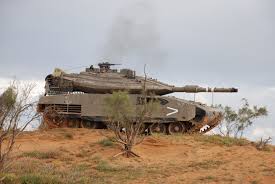
The legacy of the Merkava series of tanks dates back to the 1960s.
Plans were drawn up to isolate Israel's military-industrial complex from foreign reliance.
Israel's economy and national reserves, backed by U.S. military grant aid, allowed it to purchase nearly any land, sea, or air platform and weapon from friendly nations, but Israel's infrastructure was not capable of producing those items domestically.
In 1965, Israel's military establishment initiated research and development for a domestically-produced tank, the Sabra (Hebrew slang: "Native"). During the design of this platform, Britain approached Israel and requested their assistance in developing the United Kingdom's newest tank, the Chieftain.
When two prototypes arrived for field testing in 1967 Israel shelved the Sabra program.
As a result of political pressure from the British Foreign Ministry the two prototypes were recalled to England in 1969, and Israel lost five years with which it could have pursued its own development program[6].
Following this incident, Israel Tal—serving as a brigade commander after the Suez Crisis—restarted plans to produce an Israeli-made tank.
Tal's mission was furthered by lessons learned in the 1973 Yom Kippur War, where the Middle East's Arab nations held significant numerical superiority. Realizing that they could not win wars of attrition, the new tank platform would have heavy requirements for crew survivability and safety[6].
By 1974, initial designs were completed and prototypes were fabricated. After a brief set of trials, work began to retool the Tel-Hashomer ordnance depot for full-time development and construction of the infant platform.
After the new facilities were completed, the Merkava was officially released to the public in the International Defense Review periodical. Additionally, the first official images of the tank were then released to other publications, specifically the American periodical Armed Forces Journal on May 14, 1977.
The IDF's official adoption would not occur until December 1978 when the first full battalion of thirty tanks was delivered for initial unit training.


